• Part: AD8341
  • Description: 1.5GHz to 2.4GHz RF Vector Modulator
  • Manufacturer: Analog Devices
  • Size: 633.99 KB
Download AD8341 Datasheet PDF
Analog Devices
AD8341
AD8341 is 1.5GHz to 2.4GHz RF Vector Modulator manufactured by Analog Devices.
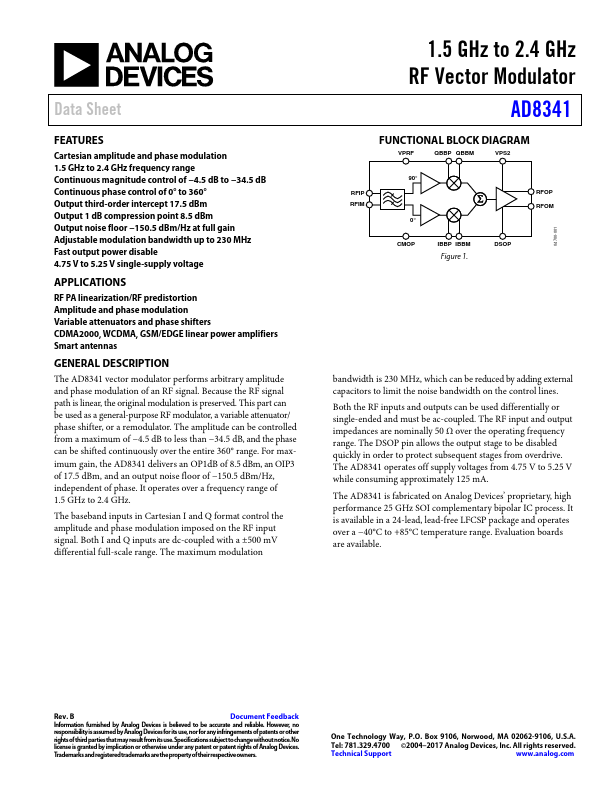
Data Sheet Features Cartesian amplitude and phase modulation 1.5 GHz to 2.4 GHz frequency range Continuous magnitude control of - 4.5 d B to - 34.5 d B Continuous phase control of 0° to 360° Output third-order intercept 17.5 d Bm Output 1 d B pression point 8.5 d Bm Output noise floor - 150.5 d Bm/Hz @ full gain Adjustable modulation bandwidth up to 230 MHz Fast output power disable 4.75 V to 5.25 V single-supply voltage 1.5 GHz to 2.4 GHz RF Vector Modulator AD8341 FUNCTIONAL BLOCK DIAGRAM VPRF QBBP QBBM VPS2 90° RFIP RFIM 0° 04700-001 RFOP RFOM CMOP IBBP IBBM DSOP Figure 1. APPLICATIONS RF PA linearization/RF predistortion Amplitude and phase modulation Variable attenuators and phase shifters CDMA2000, WCDMA, GSM/EDGE linear power amplifiers Smart antennas GENERAL DESCRIPTION The AD8341 vector modulator performs arbitrary amplitude and phase modulation of an RF signal. Since the RF signal path is linear, the original modulation is preserved. This part can be used as a general-purpose RF modulator, a variable attenuator/phase shifter, or a remodulator. The amplitude can be controlled from a maximum of - 4.5 d B to less than - 34.5 d B, and the phase can be shifted continuously over the entire 360° range. For maximum gain, the AD8341 delivers an OP1d B of 8.5 d Bm, an OIP3 of 17.5 d Bm, and an output noise floor of - 150.5 d Bm/Hz, independent of phase. It operates over a frequency range of 1.5 GHz to 2.4 GHz. The baseband inputs in Cartesian I and Q format control the amplitude and phase modulation imposed on the RF input signal. Both I and Q inputs are dc-coupled with a ±500 m V differential full-scale range. The maximum modulation bandwidth is 230 MHz, which can be reduced by adding external capacitors to limit the noise bandwidth on the control lines. Both the RF inputs and outputs can be used differentially or single-ended and must be ac-coupled. The RF input and output impedances are nominally 50 Ω over the operating frequency range. The DSOP pin allows the output...